
7 Signs You Need to Replace Your Electrical Panel | Richmond VA
Your home’s electrical panel is the control center for every circuit in the house. Every light switch, outlet, appliance, and charger runs through it. When the panel works, you never think about it. When it does not, you notice fast.
The problem is that many panels fail slowly. They do not announce themselves with sparks or a loud pop. They wear out quietly over decades, and by the time the symptoms show up, the risk has been building for years.
Many homes across Richmond, Henrico, Chesterfield, and Hanover still rely on panels that were installed 30 or 40 years ago. These panels were designed for a fraction of the electrical load that a modern household demands. Air conditioning, heat pumps, EV chargers, home offices, and kitchen appliances have all pushed residential power needs well beyond what a 100 amp panel from the 1970s was built to handle.
Here are seven signs that your panel may need to be replaced, even if nothing seems obviously wrong.
Signs It Might Be Time for a Panel Replacement
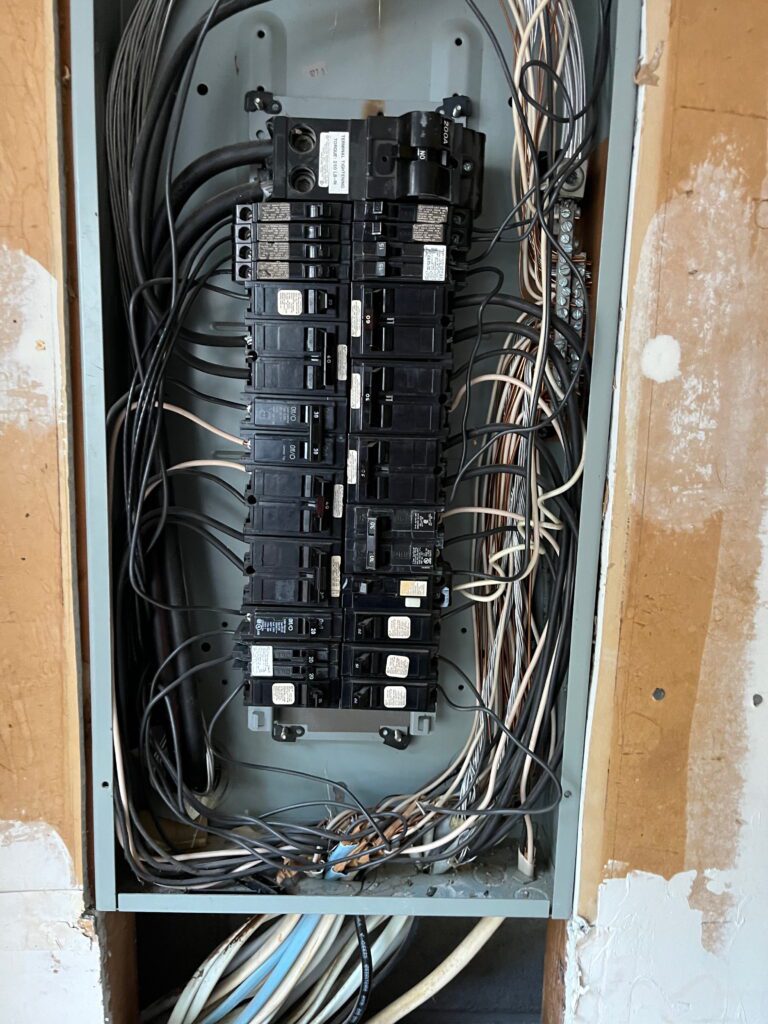
1. Your breakers trip frequently
Every breaker trips eventually. That is what it is designed to do. But if you are resetting the same breaker once a week, or if running the microwave and the hair dryer at the same time kills a circuit, the panel is telling you something.
Frequent trips usually mean the panel is at or near capacity. The circuits are overloaded, and the breakers are doing their job by shutting off before the wiring overheats. The fix is not a bigger breaker (that actually makes things more dangerous). The fix is more capacity, which usually means a panel upgrade to 200 amps.
2. The panel is more than 25 years old
Panels do not have a hard expiration date stamped on the door, but the industry consensus is that most residential panels should be evaluated after 25 years. After 30, replacement is almost always the right call.
Components fatigue. Bus bars corrode. Breaker springs lose tension. Connections loosen from years of thermal expansion and contraction. None of this is visible from the outside. The panel can look fine and still be degrading internally.
If your home was built before the mid 1990s and the panel has never been replaced, it is worth having a licensed electrician open the cover and take a look.
3. You have a Federal Pacific, Zinsco, or Pushmatic panel
This is the most urgent item on the list.
Federal Pacific Electric (FPE) panels with Stab-Lok breakers were installed in millions of American homes between the 1950s and 1980s. Independent testing has shown that up to one in four Stab-Lok breakers fail to trip during an overload. The Consumer Product Safety Commission has linked these panels to an estimated 2,800 house fires per year.
Zinsco panels (sometimes rebranded as GTE Sylvania) were popular in the same era. Their breakers are known to fuse to the bus bar, which means they physically cannot trip when they need to. An overloaded circuit stays hot. That is how fires start.
Pushmatic panels used a push button design instead of a toggle switch. Parts are no longer manufactured, which means a failed breaker cannot be properly replaced. Some electricians will install aftermarket breakers that do not fit correctly, which introduces its own set of risks.
Richmond has thousands of homes in the Museum District, Church Hill, Bellevue, Westover Hills, Bon Air, and the Henrico suburbs that were built during the decades when these panels were standard. If you see any of these names on your panel door, do not wait. Schedule an inspection.
4. You see visible damage, discoloration, or smell something burning
Open the panel door (it is safe to open the outer door) and look. Scorch marks, melted plastic, rust, or corrosion on the breakers or bus bars are all signs that something has already gone wrong.
A burning smell near the panel, even a faint one, means wiring or insulation is overheating. This is not a “watch it and see” situation. Turn off the main breaker and call an electrician the same day.
One of our customers in Richmond heard a sizzling sound from the panel for weeks before calling us. Less than 30 minutes after they finally recorded the sound on video, the smoke alarm went off. The panel was on fire. Catching it earlier would have been a much simpler job.
5. You have added load to the house
Homes change. Kitchens get remodeled. HVAC systems get upgraded. Hot tubs go in. Home offices get wired. And increasingly, EV chargers get mounted in the garage.
A Level 2 EV charger alone draws 30 to 50 amps. A heat pump might add 40 to 60. If the original panel was sized at 100 or 150 amps, there may not be enough capacity left for a safe installation. Running new high draw equipment on an undersized panel is not just inefficient. It is a fire risk.
Before any major electrical addition, a licensed electrician should run a load calculation to confirm whether the existing panel can handle it. If it cannot, a 200 amp service upgrade solves the problem and gives the house room to grow.
6. You are out of breaker space
Open the panel and count the breaker slots. If every slot is full and someone has already installed tandem breakers or (worse) double tapped two wires onto a single breaker, the panel has no room left.
Double tapping is a code violation. Tandem breakers are acceptable in certain panel models and certain slots, but they are often used as a workaround to avoid the real conversation, which is that the panel needs more space.
If you need to add circuits for a remodel, an EV charger, or a generator transfer switch and there is no room, a panel replacement or a subpanel addition is the path forward.
7. Your insurance company or home inspector flagged it
Insurance companies have gotten much more aggressive about electrical panels in the last few years. Many carriers in Virginia will not write or renew a policy on a home with a Federal Pacific, Zinsco, or fuse box panel. Some require a panel upgrade as a condition of coverage.
Home inspectors flag the same issues during real estate transactions. If you are selling a home in Richmond and the inspection report calls out the panel, the buyer’s lender may require the upgrade before closing. Getting ahead of this saves time, reduces negotiation friction, and often pays for itself in the sale price.
Why a Panel Replacement Matters Beyond Safety
Safety is the primary reason. But a modern panel also:
Protects your electronics. Inconsistent voltage from a failing panel can damage computers, TVs, refrigerators, and other sensitive equipment over time.
Increases your home’s resale value. A new 200 amp panel with a clean permit and inspection on record is a selling point that buyers and inspectors notice.
Unlocks future upgrades. Want an EV charger, a heat pump, solar panels, or a standby generator? All of them need capacity. A new panel makes every future project easier and less expensive.
Keeps your insurance premiums stable. A modern, code compliant panel removes one of the most common reasons insurers raise rates or drop coverage on older Richmond homes.
What a Panel Replacement Looks Like with Allied Electric
Most residential panel replacements in the Richmond metro take one day. Here is what happens:
- Assessment. Wes visits your home, opens the panel, and evaluates the condition, capacity, and wiring. You get a written quote the same day.
- Permits and coordination. We pull the City of Richmond or county electrical permit and submit the Dominion Energy work request for the meter pull.
- Installation. The old panel comes out. The new panel goes in. All circuits are reconnected, labeled, and tested. The house is typically without power for 4 to 6 hours.
- Inspection. The city or county inspector signs off. Dominion reconnects the meter. Power is back on by evening.
- Warranty. Every panel we install carries a one year workmanship warranty. If something is not right, we come back and fix it.
We serve homeowners across the City of Richmond, Henrico, Chesterfield, Hanover, Goochland, Mechanicsville, Glen Allen, Short Pump, Midlothian, and Bon Air.
Frequently Asked Questions
How much does a panel replacement cost in Richmond VA? Most 200 amp panel replacements in the Richmond metro range from $2,500 to $5,500 depending on the condition of the existing wiring, the location of the panel, and whether the meter base or weatherhead needs to be replaced at the same time. We provide a written quote before any work begins.
Do I need a permit to replace my electrical panel in Richmond? Yes. The City of Richmond and the surrounding counties (Henrico, Chesterfield, Hanover) all require an electrical permit for a panel replacement. A licensed electrician pulls the permit, and a county or city inspector signs off when the work is done. Dominion Energy also requires a work request number before they will pull and reset the meter.
How long does a panel replacement take? Most residential panel replacements are completed in a single day. Your power will be off for roughly 4 to 6 hours during the swap. We schedule to have everything buttoned up and power restored by the evening.
Will my insurance require me to replace my panel? It depends on the panel. Many Virginia insurance carriers will not cover homes with Federal Pacific, Zinsco, or fuse box panels. If your insurer has flagged your panel or raised your premium, a replacement usually resolves the issue.
Can I just replace a few bad breakers instead of the whole panel? In some cases, yes. But if the panel itself is the problem (outdated brand, corroded bus bars, insufficient capacity), swapping individual breakers does not fix the root issue. A full panel replacement is the safer and more cost effective solution long term.
Does Allied Electric offer financing for panel replacements? Contact us to discuss payment options. We want to make sure cost does not stand between your family and a safe electrical panel.